A suicide bomber has killed at least 27 people at a Shia Muslim mosque in the Afghan capital, Kabul.
Many more were wounded in the blast at an annual Shia ceremony at the Baqir ul Olum mosque in the west of the city.
The attacker arrived on foot and blew himself up among worshippers inside.
So-called
Islamic State (IS) said that it was behind the blast. It is the latest
of several recent attacks on Afghanistan's Shia community claimed by the
Sunni Muslim militant group.
Monday's bombing took place at
12:30 local time (08:00 GMT) during a service to commemorate the death
of Imam Hussein, the Prophet Muhammad's grandson and a Shia martyr.
Sunnis and Shia: Islam's ancient schism
Eyewitnesses said the service was almost over when the bomb was detonated.
Police
gave the figure of 27 dead, but the UN Assistance Mission in
Afghanistan said 32 were killed and more than 50 injured. Some reports
suggest a higher number of wounded.
IS said the attack was carried out by an IS "fighter" but gave no other details on its self-styled Amaq news agency.
"I
was inside the mosque and the Mullah was reading the prayer," Ewaz Ali,
50, who suffered minor injuries, told the Associated Press news agency.
"Suddenly a huge explosion happened, then everywhere was dark."
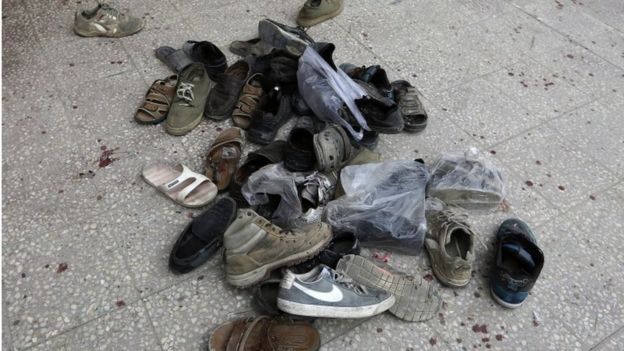
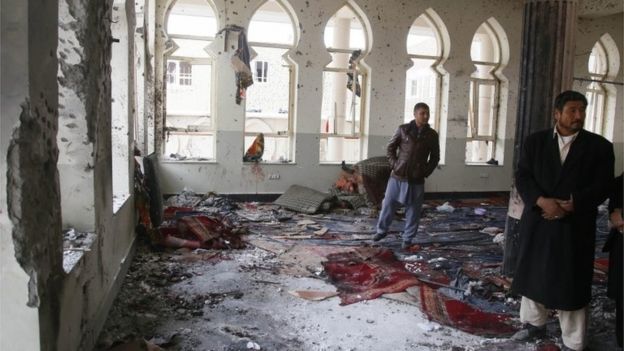

Another worshipper, Nadir Ali, told AFP news agency the blast had
created a cloud of dust: "When the dust settled down, I saw the mosque
was full of flesh and blood. I was injured in my waist and had to crawl
out of the mosque."
Local reports suggested children were among the dead.
There
has not been a proper census for more than 40 years, but it is
estimated that around 20% of the Afghan population are Shia Muslims -
the rest are Sunni. Most Shia Muslims come from the Tajik and Hazara
ethnic minorities.
They have been spared levels of sectarian
violence seen in Pakistan and Iraq, but they have been targeted at least
three times in recent months:
- In a gun attack on a shrine in Kabul in October in which at least 14 people died
- In an explosion at a mosque in October in the northern province of Balkh in which at least 14 people died
- In a suicide bomb attack on a Shia protest march in July, which left 80 dead
All three attacks were claimed by IS.
Groups
affiliated to IS, present in the eastern Afghan province of Nangarhar
along the Pakistan border, seem intent on fomenting sectarian violence,
says the BBC's Harun Najafizada in Kabul.
What is really worrying
is that fragile national unity now seems to be targeted, with possibly
devastating results if such attacks continue, our correspondent adds.

Taliban militants were quick to distance themselves from Monday's attack.
"We
condemn this blast," Taliban spokesman Zabihullah Mujahid told the BBC.
"This act cannot be our work and has nothing to do with us."
President Ashraf Ghani called the attack an attempt "to sow seeds of discord".
Afghan
government Chief Executive Abdullah Abdullah urged the country not to
fall victim to "enemy plots that divide us by titles".
"This
attack targeted innocent civilians - including children - in a holy
place," he said via Twitter. "It is a war crime and an act against Islam
& humanity."


 The section of the motorway where the robbery took place is favoured
by criminals targeting luxury cars or wealthy-looking foreigners stuck
in traffic jams:
The section of the motorway where the robbery took place is favoured
by criminals targeting luxury cars or wealthy-looking foreigners stuck
in traffic jams: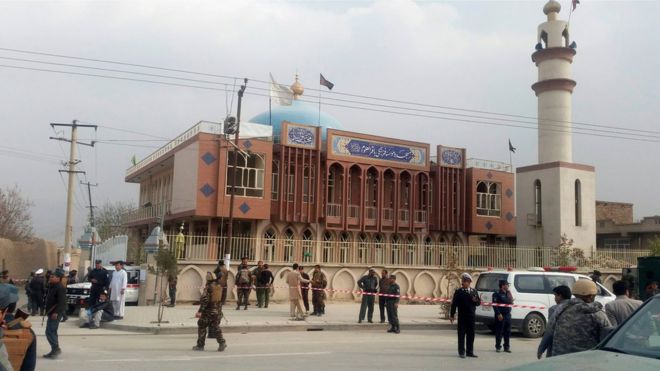


 Posts
Posts

